Accelerate Succession — And Other Utopian Visions
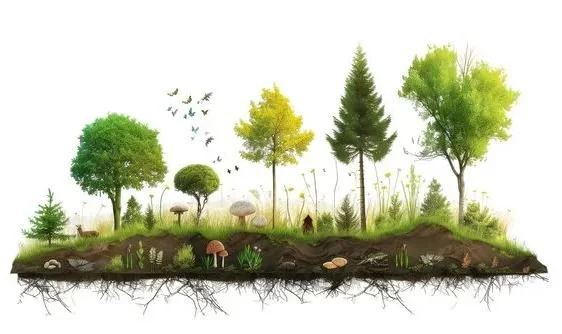
Take a moment to observe natural succession in the landscape. You don’t have to be in the countryside. You can find it in towns and cities too.
Where I live, brambles and blackthorn advance quickly into any un-grazed fields and press at garden edges. With them come gorse and hawthorn and, not far behind, hazel and ash.
The forest wants to return.
And we fight it.
Fields and gardens are fiercely maintained, and the linear woodland of hedgerows is flailed into stunted submission.
The clearing has been going on for a long time, and for reasons that seem obvious: if we want gardens and fields then all of this tumbling succession has to be arrested.
How then are we meant to interpret the Permaculture principle ‘Accelerate Succession?’
At its simplest it is read as an injunction to move away from bare earth farming or gardening, to cover the ground to protect the soil in something wilder than its plough-turned state. There are all kinds of horticultural challenges with this, especially for those of us in cold humid climates, plagued by slugs, rain, and long winters. All the ploughing and the digging was done for what seemed like good enough reasons.
Even in nature, ground is sometimes cleared. Animals clear land, the big ones very obviously, think of wild boar, but also the little ones. Anywhere there is a healthy population of moles will have hundreds if not thousands of beautifully tilled seedbeds from early spring onwards. Falling trees clear ground as well, as the root plates are torn from the earth; and inundation, silting, erosion and landslides, including frost action on banks, can all create clear ground. Cleared patches of ground become, for a while, annual gardens.
Despite the shifting patchwork of cover though, all other things being equal, most ground is, for most of the time, under plant cover. Left alone, here at least, it will move towards woodland.
Succession is soil-building and ecologically complexifying, as species find places in new niches created. A patch of grass will fall to brambles and gorse, and from that thorny briar, trees will emerge. No successive state will entirely remove the representatives of earlier ones. In the space of a few years we can go from monoculture to an assembly of hundreds of species, including fungi, insects, amphibians, reptiles, birds and mammals.
To the farmer or gardener this can all look like a bloody mess with no yield except blackberries for those children hardy enough to go picking them in the autumn.
We have two apparently incompatible imperatives: the production of crops so that we can eat, and the acceleration of succession so that soils, soil life, and the Earth herself may thrive.
How then do we cope with the unreasonable jungle-making demand to accelerate succession?
I want to be clear: accelerating succession wins, as a principle, as a directive, it wins the argument, globally, every time. It must, because it, and not us, restores the natural systems upon which all life depends. We must fit around succession, not the other way around.
The very minimum position then, is to choose another place to arrest succession, other than bare earth and the plough. In some places, practicing intensive growing, we may mulch, or grow cover crops and green manures, always farming to maintain soil life and the plant cover upon which it depends. This can be your potato patch, your beanfield, your market garden.
We go a little further when we introduce useful species which fit into the signal our local succession is giving us. Here we allow the soil to cover itself, but we add perennial herbaceous plants, soft fruit, fruit and nut trees; we trial perennial cereals and production of fungi in partial shade, and we plant deep-rooted mulch plants and nutrient pumps like comfrey and chicory.
In broad landscapes we can shift as woodland overtakes us, doubling back into coppiced areas, or into the clearings of fallen or selectively felled trees. If we’re more limited for space then we can stop at perennial gardens, mimicking little forests, as full as we can make them, with no space for brambly invaders from the edges of the wildwood.
As whole landscapes fill with patchworks of wild succession and the shifting gardens and farms that we have introduced, then there will be a moment at which we can allow large animals to play their own clearing role. We will see the breaking of trees as the acceleration of carbon pathways, the return to the brown and green mosaic of succession in full flow that represents the oldest pattern of the land since the ice melted.
The crux of the problem is cultural. It’s really about what we eat, and when, and why. A temperate landscape in full spate of natural regeneration and succession, interspersed with small clearing gardens and shifting, fuzzy-edged farms, would be productive of food beyond the wildest dreams of someone walking the green deserts of intensive dairying country today. The woodlands themselves would be full of food, and the rivers too, and the small clearing gardens would never be short of fertility or of mulch materials.
And we would have learned by then the real lesson of the principle ‘Accelerate Succession,’ which is that we must be a part of it too. Accelerating succession is the path to abundance of food, of fibre, fuel, building materials, and medicines.
We have traded all of that for supermarkets and monocultures, for rivers without fish, forests without game, and verges without greens for our tables.